

Tech Rout: Are We Nearing the Point of Maximum Fear? (29 Jul 2026)
Dear readers,
It has been a while since my last article. Over the past few weeks, I have been occupied with client meetings, discussions with listed companies ahead of their blackout periods, as well as engagements with analysts, investor relations teams and other members of the investment community. Readers who are interested can follow some of these interactions on my LinkedIn profile HERE.
During lunch today, I sent a short market update to my clients and thought it would be worthwhile sharing a revised version here on the blog.
KOSPI: Down 44% From Its Recent Peak
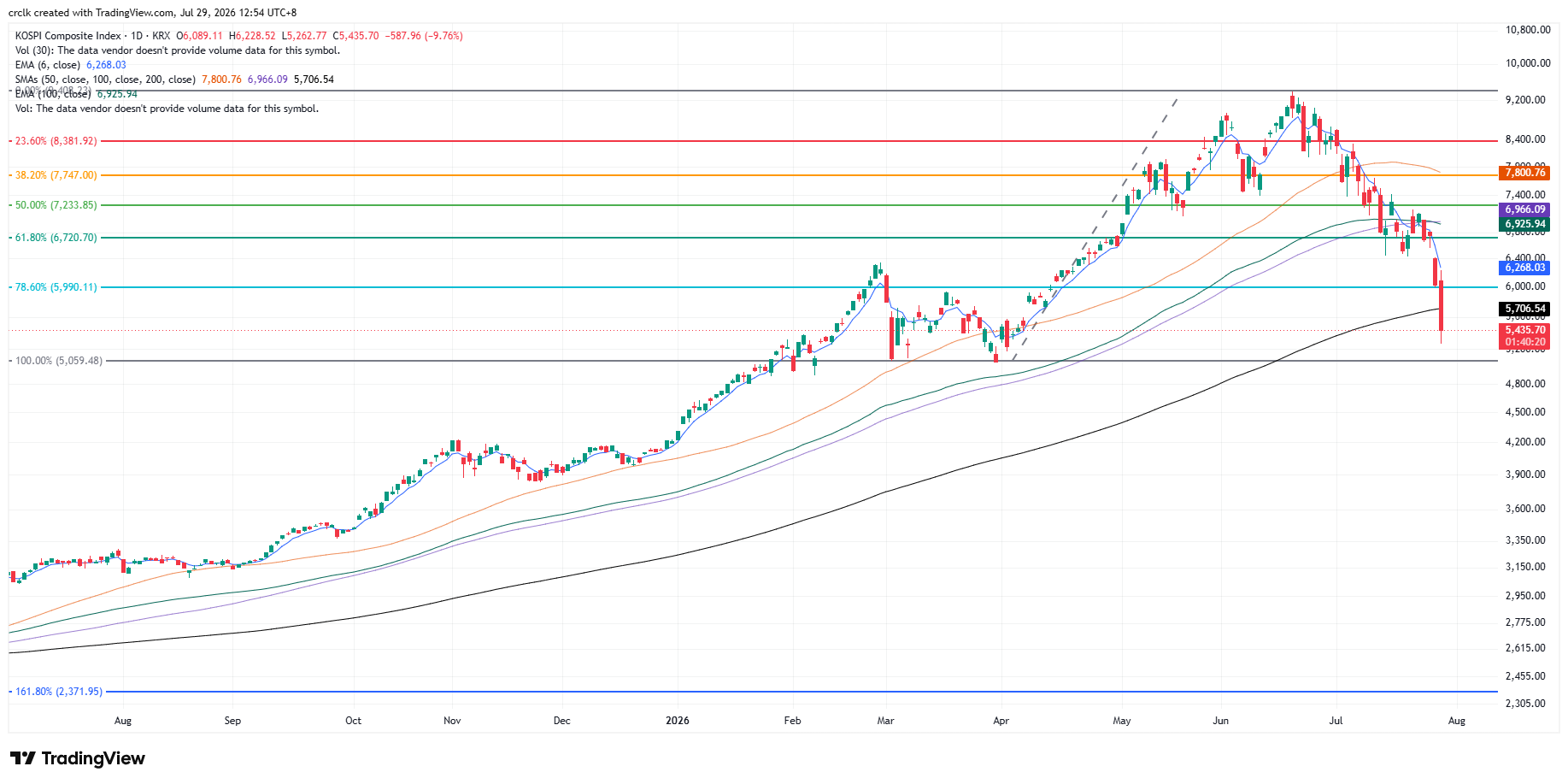
At lunchtime today, the KOSPI was trading around 5,271, representing a decline of approximately 12.5% for the day. Since reaching a record high of 9,386 on 19 June, the index has fallen about 44%.
Today’s session also marked the first time the KOSPI experienced back-to-back circuit breaker suspensions. Of the 15 circuit breaker events recorded by the benchmark index since 2000, at least nine have occurred this year alone, highlighting the severity of the ongoing sell-off. The index traded within a wide intraday range of 5,263 to 6,229.
Meanwhile, SK Hynix—one of the market’s bellwethers—at one point recorded a two-day decline of 30%. The stock is now down roughly 53% from its peak of KRW2,987 reached on 25 June 2026.
From a technical perspective, the KOSPI’s Relative Strength Index (RSI) is currently around 29, signalling oversold conditions. Based on Chart 1 below, a key support zone appears to be in the 4,945–5,075 range. Even if the index were to retest the lower end of this support band, the additional downside from today’s level of 5,271 would be approximately 6.2%. With many technology stocks already having corrected sharply, the risk-reward profile is becoming increasingly attractive for investors.
Chart 1: KOSPI (1-Year) – Potential Strong Support at 4,945–5,075
Selected Technology Stocks: Sharp Corrections Create Better Valuations
For my clients’ reference, I compiled a list of selected technology counters and their performance relative to recent highs.
Based on this manual compilation (see Table 1 below), many technology stocks have experienced substantial declines from their respective three-month peaks.
Among the names reviewed, NanoFilm recorded the largest drop, falling 39% from its high of S$1.68 on 24 April 2026. The stock continues to be on my watchlist, and readers who are interested may refer to my earlier article HERE discussing whether the recent correction has improved its risk-reward profile.
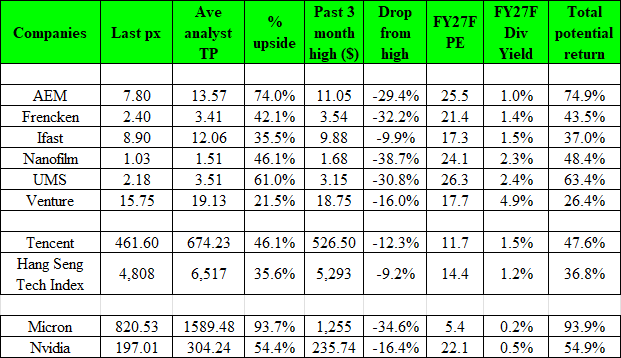
Source: Ernest; Bloomberg compilation
At the time of writing, Micron was trading at a pre-market indication of approximately US$760. Based on yesterday’s closing price of US$820, the stock was already trading at around 5.4x FY27F earnings with an August financial year-end. Such valuations would likely have appeared difficult to imagine just a couple of months ago.
Conclusion
Calling the exact bottom of a market correction is never easy and, more often than not, attempting to do so precisely and consistently is a futile exercise.
That said, based on the magnitude of the decline, oversold technical indicators, and the level of fear currently evident across markets, my view is that we may be closer to the end of this sell-off than the beginning.
Whether the market has already reached its absolute bottom remains uncertain. In the near term, investors will be closely watching several key events, including the U.S. FOMC meeting on Thursday morning, earnings releases from major technology companies such as Meta, Microsoft, Amazon, Apple and Samsung Electronics, as well as important economic data points including U.S. Core PCE inflation. While these developments could continue to drive volatility, the sharp correction across technology stocks has also resulted in meaningfully more attractive valuations. For long-term investors, opportunities may gradually be emerging as fear and uncertainty become increasingly reflected in share prices.
As always, let us see how events unfold over the coming months.
Disclaimer
This article is provided solely for general information and educational purposes and should not be construed as financial advice or a recommendation to buy or sell any security.
Every investor’s financial circumstance, investment objective and risk tolerance are different. Please conduct your own due diligence and, where appropriate, consult a licensed financial adviser before making any investment decision.
I am vested in AEM, iFast, NanoFilm, Tencent, Hang Seng Tech ETF.
If you would like to receive future write-ups, you may subscribe through my blog HERE.
As more detailed analyses are usually shared with my clients first, articles published on my blog may occasionally appear after the initial investment opportunity has emerged.
If you are interested in working together, feel free to contact me at crclk@yahoo.com.sg.
Please refer to the full disclaimer HERE