

Geo Energy – Riding the Wave of ASP, Margins & Volume (21 Sep 26)
Dear all,
It’s been a while since my last post (“Tech Rout: Are we nearing the point of maximum fear” dated 29 Jul) (click HERE). Markets have been relentless, and I even had to skip an overseas work site visit to be in Singapore to service clients and to better monitor the markets effectively. 😊
Back in June, I flagged Geo Energy (Geo) to clients when it traded around $0.425–0.435. Since then, it touched an intraday high of $0.575 on 3 Sep before easing to $0.540, despite coal prices hitting multi‑month highs. Analysts remain constructive, with target prices ranging from $0.75 to $1.15.
So, what’s the market missing?
I am fortunate to have an exclusive 1-1 call with Geo’s management and here are my personal key takeaways after combining with what I have read and the various analyst reports.
Company Snapshot
Geo, established in 2008 and listed on the SGX Mainboard since 2012, is an Indonesian energy group focused on the efficient production of premium, low-ash and low-sulphur thermal coal. The Group owns three mining concessions across Kalimantan and South Sumatera (TBR, SDJ, and TRA coal mines), as well as a 49% stake in PT Internasional Prima Coal, a joint venture with state-owned PT Bukit Asam.
Beyond mining, Geo has expanded downstream into logistics, with a 71.3% effective interest in PT Marga Bara Jaya (MBJ) — its integrated haul road and jetty infrastructure went live in July 2026 — plus a 51% stake in shipping companies supporting coal transport.
Why 2HFY26 Could Surprise
In 2HFY26F, the following factors should play out.
A) Surge in coal prices
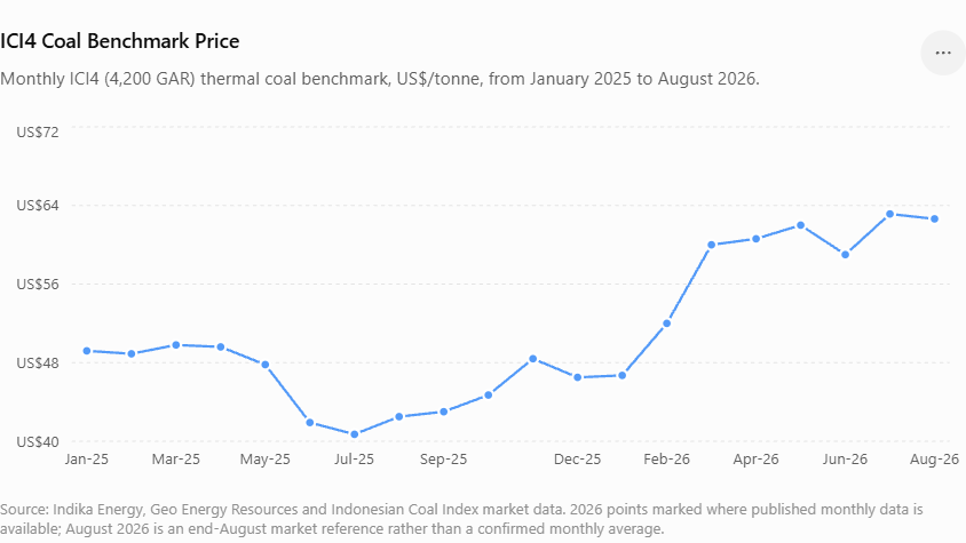
Based on Chart 1 below, ICI4 benchmark has rebounded sharply from mid‑2025 lows. From US$41/t in June–July 2025, it averaged US$58.13/t in 1H2026 and hit US$63.14/t in July 2026. My channel checks show prices are above US$70/t in Sep which should bode well for Geo. It is also noteworthy that Geo’s 3QFY25 ASP were US$40.09/t, hence current prices are significantly higher than that of 3QFY25.
Chart 1: ICI4 Coal Benchmark Price
B) Volume recovery
In line with their mining plan, Geo delivered coal sales of 3.6m tonnes in 1H2026 (1H2025: 6.3m tonnes), but with expected higher volumes in 2H2026, it is on track to achieve targeted coal production of 11.5–12.5m tonnes for 2026.
Geo has planned their mining plan such that, they will produce more coal especially from their TRA mine and transport this coal using their MBJ Infrastructure (just operational in Jul 2026). It is also timely given that coal prices have rallied further in 3Q. Analysts are projecting 2HFY26 coal production will jump 36% – 39% to around 8.0 – 8.2m MT vis-à-vis 2HFY25.
C) Cost efficiency via MBJ
Before MBJ, Geo uses Atlas road which is a long, narrow mixed use 140-km road (Mixed use means – it has both forestry and mining haulage trucks operating on it). Atlas can support 30-tonne trucks and can only service one round trip a day.
The newly constructed full pavement, private haul road infrastructure (MBJ) spans 92 km. It can support 70-tonne trucks and each truck can easily complete at least 2 round trips a day. Thus, the jump in productivity is enormous.
Besides the significant jump in productivity, MBJ is 71.3% effectively owned by Geo. Thus, instead of paying to external toll road operators to use Atlas road, now, they can transport via MBJ, resulting in cost savings. According to Geo, TRA’s full ramp‑up to 25m tonnes in the next few years could potentially add up to US$350m in EBITDA annually.
MBJ also opens a new recurring revenue stream. Leasing excess capacity (25m tonnes) to third‑party miners could generate up to US$250m EBITDA per year. Binding term sheets for 9m tonnes have already been signed, with maiden contributions likely in 2HFY27F.
2) Other positive factors
A) TRA / MBJ Investment – Showcases management’s vision and execution strength
This is a point worth emphasising.
Geo’s TRA/MBJ investment showcases management’s vision and execution strength. Three years after acquiring TRA mine and MBJ, the company has proven the strategic rationale behind its 2023 move. By identifying TRA’s logistical bottlenecks, securing MBJ as the solution, committing significant capital, and overcoming the challenges of building a 92km dedicated haul road and jetty in South Sumatra, Geo successfully brought MBJ into operation in July 2026.
Although completion took longer than the initial 18–24-month estimate, MBJ’s launch transforms the acquisition from a paper plan into a functioning infrastructure platform. Importantly, MBJ’s first shipment signals more than just a new haul road — it represents a structural shift in South Sumatra’s coal industry, where control of roads, terminals, and loading facilities could become as valuable as coal reserves themselves.
B) MBJ Infrastructure receives an external validation by ResInvest
On 11 May 2026, Geo announced ResInvest’s planned investment in MBJ at a US$1.5b valuation. If finalised, this validates MBJ’s intrinsic worth. Geo’s effective 71.3% stake translates to ~S$1.36b, versus its current market cap of ~S$959.5m — highlighting the potential disconnect between market valuation and underlying asset value.
C) Next two months are key
Additional double‑trailer trucks are expected from October, supporting management’s target of 0.8–1.0m tonnes of monthly TRA production in the final four months of 2026.
Separately, Geo’s 11 May announcement indicated that updates on ResInvest’s MBJ investment could be forthcoming. If progress materialises as planned, the next two months may prove pivotal for both operational ramp‑up and external validation.
D) TBR coal production volume set to rise from 2.0m tonnes in 1HFY25
In 1HFY26, TBR coal mine production was around 2.0m tonnes as compared to 3.8m tonnes in 1HFY25. In 1HFY26 results, Geo mentioned that they have spent US$35m for the overburden removal of the highwall to access further coal reserves at the joint boundary of TBR mine. Thus, besides the significant ramp up in TRA mine coal production in the next few years, coal production at TBR mine should also be higher in 2HFY26 and FY27F.
E) Share purchases between $0.515 – 0.560
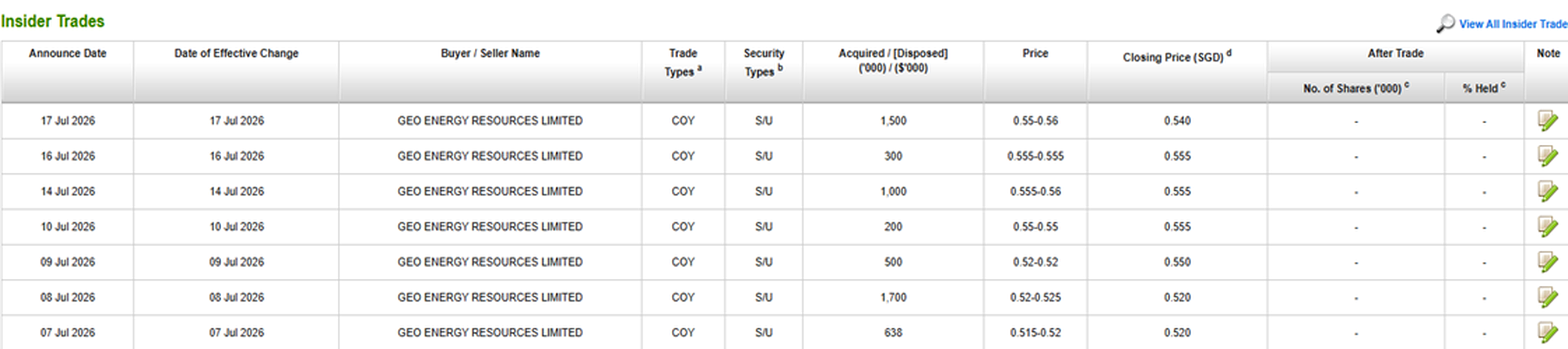
Based on Chart 1 below, Geo repurchased approximately 5.84m shares at an estimated average price of around S$0.539 per share, representing gross consideration of approximately S$3.15m between 7 and 17 July 2026. This may arguably indicate that management views the share price of around $0.515 – 0.560 as attractive.
Chart 1: Geo’s company share buybacks
F) Technical support around $0.520 – 0.525
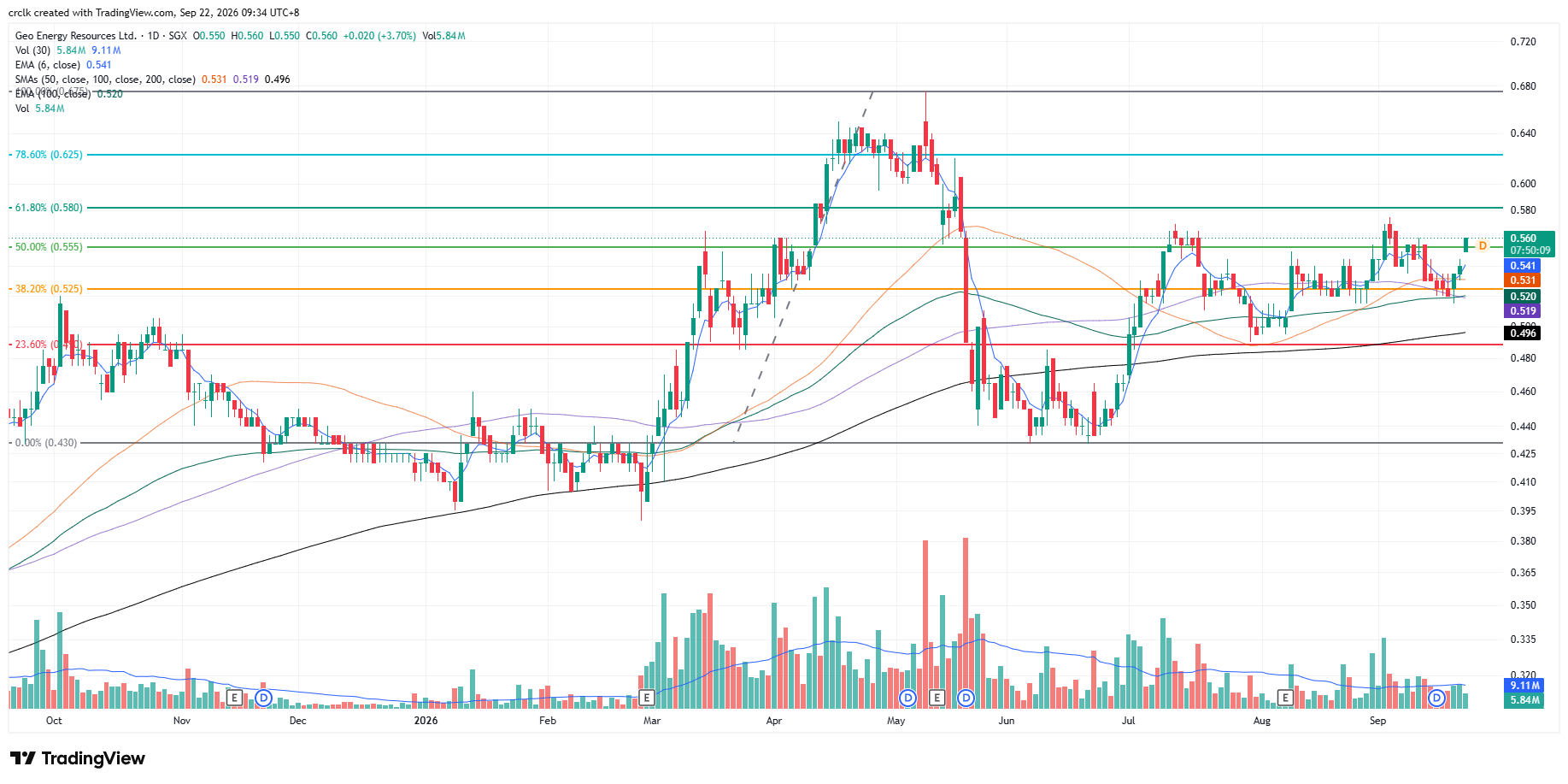
Geo’s stock price has retreated 20% after hitting a high $0.675 on 11 May to close at $0.540 on 21 Sep. Based on Chart 2 below, Geo should see a good support region of around $0.52-0.525 (supported by a confluence of 50D, 100D SMA and Fibo), followed by $0.490-0.500 (Fibo, 200D SMA).
Near term key resistance is around $0.570 – 0.580, followed by $0.640 – 0.650.
Chart 2: Geo’s 1st strong support $0.52 – 0.525
Key potential risks to watch in Geo Energy
Examples of some potential risks in Geo are
A) Indonesia political risk
Political developments in Indonesia remain a significant risk factor. Danantara has indicated that existing commercial relationships may continue as long as transactions comply with regulations and avoid under‑invoicing. DSI is expected to act as an intermediary, facilitator, and digital‑monitoring platform rather than replace miners’ current arrangements. President Prabowo has further reassured industry participants that DSI will oversee commodity exports without assuming control, aligning with management’s view that customer purchasing behaviour remains unchanged. That said, evolving implementation requirements and changes to pricing documentation could still pose operational challenges.
B) Weather impact on coal production
Super El Niño conditions typically favour coal production and transport due to drier weather. However, extreme heat can also trigger widespread fires or water shortages, potentially disrupting logistics and transportation networks. The net impact remains uncertain and could swing either way depending on severity.
C) Coal price volatility
A sharp decline in coal prices would directly pressure producers like Geo. While current dynamics — including Super El Niño and elevated gas prices driven by prolonged geopolitical tensions between Iran and the U.S. — may support coal prices in the near term, volatility remains an ever‑present risk.
D) Limited analyst coverage & institutional interest
Coal companies often face reduced coverage and institutional participation due to ESG considerations. This lack of attention can limit liquidity and valuation support. On the flip side, it also leaves room for price discovery as Geo continues to execute its strategy, potentially creating opportunities for investors willing to look beyond mainstream coverage.
E) MBJ EBITDA Projections
Geo’s announcements around MBJ highlight potential EBITDA contributions of up to US$600m. These figures, however, are projections subject to multiple assumptions — including TRA mine hitting production targets, government approval of quotas, sustained third‑party demand, agreed transport tariffs, and uninterrupted river access. Management has cautioned that actual results could differ materially from estimates, underscoring execution risk.
Conclusion
Geo Energy presents a compelling yet complex setup heading into 2HFY26. Rising ASPs, volume recovery, and infrastructure gains through MBJ provide strong tailwinds, but execution risks and external uncertainties cannot be ignored. For investors, this is a name worth keeping on the watchlist — one where disciplined monitoring of coal prices, regulatory developments, and MBJ’s ramp‑up will determine whether the story delivers on its promise.
As always, do your own due diligence and refer to analyst reports HERE before making any investment decisions.
P.S: I am vested in Geo and have highlighted to my clients last week.
Disclaimer
This article is provided solely for general information and educational purposes and should not be construed as financial advice or a recommendation to buy or sell any security.
Every investor’s financial circumstance, investment objective and risk tolerance are different. Please conduct your own due diligence and, where appropriate, consult a licensed financial adviser before making any investment decision.
If you would like to receive future write-ups, you may subscribe at my blog HERE.
As more detailed analyses are usually shared with my clients first, articles published on my blog may occasionally appear after the initial investment opportunity has emerged.
If you are interested in working together, feel free to contact me at crclk@yahoo.com.sg. [Besides potential clients, I am actually looking for a dealing assistant :)]
Please refer to the disclaimer HERE