

Yangzijiang Shipbuilding: A 14% Correction, Yet Analysts Continue to Raise Their Target Prices. What Is the Market Missing? (2 Nov 2026)
At the time of writing, YZJSGD last traded at S$4.64, up S$0.09. Based on Bloomberg data, the consensus target price stands at S$5.65, while the estimated FY26F dividend yield is approximately 5.6%.
If consensus expectations are achieved, investors could potentially enjoy a total return of approximately 27.4%, comprising capital appreciation and dividends.
So, what are the key investment merits, and what could the market be overlooking?
✅ 5 Positive Investment Merits
1. Record Orderbook Provides Multi-Year Earnings Visibility
YZJSGD’s orderbook stands at approximately US$22.4 billion, comprising 256 vessels, with deliveries extending through to 2030.
In fact, new orders are already being booked into 2030 delivery slots.
Potential contracts from customers such as CMA CGM and HMM could push FY2026 order wins to at least US$6 billion, comfortably exceeding management’s US$4.5 billion target.
Why it matters: A substantial orderbook provides multi-year revenue and earnings visibility. This reduces uncertainty over near-term business activity and gives investors greater confidence in the Group’s earnings outlook.
2. Industry-Leading Profitability and Execution
YZJSGD continues to deliver profitability metrics that compare favourably with global shipbuilding peers.
Some notable figures:
- Shipbuilding gross profit margin (GPM) reached a record 37.1% in 1H2026.
- 1HFY26 overall Group GPM and net profit margin (NPM) stood at 36.2% and 30.6%, respectively.
- Bloomberg consensus forecasts FY26F and FY27F Group GPM of approximately 36.2% and 35.7%, respectively.
Efficient shipyard operations, cost discipline and strong execution have enabled the Group to maintain healthy margins despite a challenging industry environment.
Why it matters: Strong profitability provides a buffer against potential industry headwinds while supporting sustainable earnings and shareholder returns
3. Favourable Vessel Delivery Mix Supports Future Earnings Growth
An important but perhaps less appreciated earnings driver is the composition of YZJSGD’s future vessel deliveries.
Over FY2027–FY2028, the Group is expected to deliver a larger proportion of higher-margin containerships secured during the strong 2023–2024 ordering cycle.
Meanwhile, lower-margin bulk carriers and tankers will gradually account for a smaller proportion of the delivery mix.
Why it matters: Earnings growth need not depend entirely on securing additional major orders. The progressive delivery of higher-margin contracts could itself support earnings growth over the next two years.
4. Strong Net Cash Balance Sheet and Attractive Dividend Yield
As at 30 June 2026, YZJSGD remained in a healthy net cash position of RMB12.5 billion.
This provides management with considerable financial flexibility to:
- Fund future capacity expansion.
- Invest strategically during industry downturns.
- Pursue attractive acquisition and business opportunities.
- Maintain healthy shareholder returns.
Based on Bloomberg estimates, FY26F and FY27F dividend yields are approximately 5.6% and 5.9%, respectively.
Why it matters: Investors potentially enjoy a combination of earnings growth and dividend income, supported by a relatively strong balance sheet.
5. Multiple Capacity Expansion Drivers Could Extend Growth Beyond 2029
One key question investors should consider is whether YZJSGD’s earnings could peak once its existing orderbook has been delivered.
Based on research from DBS Research and J.P. Morgan, the Group has several potential growth drivers that could extend its earnings cycle beyond the current orderbook.
These include:
- Hongyuan yard expansion: Potential 20% increase in capacity.
- Hongda repair and retrofitting yard: Provides additional business opportunities beyond conventional shipbuilding.
- Potential Runze greenfield yard: Could add another 24%–30% in capacity.
- LNG carrier construction: An opportunity to expand into specialised vessel construction.
- Vessel retrofitting and decarbonisation upgrades: Potential growth areas as the shipping industry transitions towards more stringent environmental requirements.
Why it matters: These initiatives could provide additional avenues for growth beyond the existing orderbook. However, their eventual contribution will depend on execution, investment requirements and market demand.
⚠️ 3 Key Risk Factors
1. Global Shipbuilding Cycle Turns Down
The shipbuilding industry is cyclical.
If demand for containerships, tankers and bulk carriers weakens significantly, new orders could slow and shipbuilding prices may come under pressure.
This could eventually affect future profit margins and earnings growth.
2. RMB Appreciation Against USD and Rising Steel Costs
Most shipbuilding contracts are denominated in USD, while a substantial proportion of production costs are RMB-based.
According to DBS Research, assuming 50% of net USD exposure remains unhedged, a 1% decline in the USD could reduce earnings by approximately 1.3%.
Separately, steel accounts for approximately one-fifth of the Group’s cost of goods sold. A 1% increase in steel prices could reduce earnings by around 0.7%.
Investors should therefore monitor both foreign exchange movements and steel prices.
3. Industry Overcapacity
Many Chinese and Korean shipbuilders are currently expanding their production capacities.
Should industry capacity grow faster than global vessel demand, competition could intensify, resulting in pricing pressure and lower industry-wide profitability.
This is particularly relevant when assessing the Group’s own expansion plans, as additional capacity does not automatically translate into higher earnings.
📈 Technical Analysis
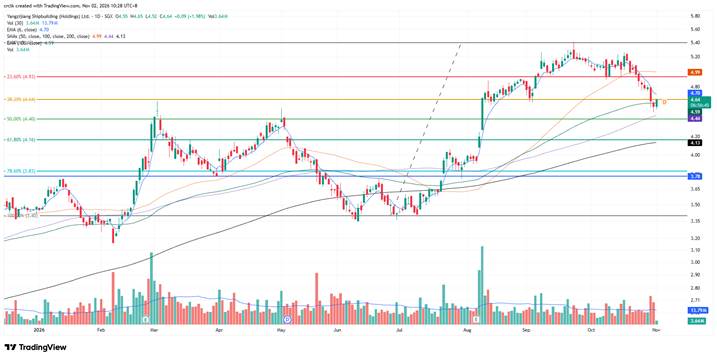
Based on Chart 1 below, YZJSGD appears to have found near-term support around S$4.50, with a stronger support zone at S$4.40–S$4.43.
The longer-term uptrend remains intact, supported by rising longer-term moving averages.
On the upside, the key resistance zone to watch is around S$4.99–S$5.00.
Key technical levels:
- Support: S$4.50, followed by S$4.40–S$4.43 (50% Fibonacci retracement and 100-day SMA).
- Resistance: S$4.64 (Fibonacci level), S$4.75–S$4.76, S$4.93 (Fibonacci level), followed by S$4.99–S$5.00 (50-day SMA).
Chart 1: YZJSGD’s support around $4.50; key resistance $4.99-5.00
Conclusion: Is the Market Overlooking Its Longer-Term Potential?
Following the recent share price correction, YZJSGD continues to offer an interesting combination of earnings visibility, healthy profit margins, a net cash balance sheet and an attractive dividend yield.
More importantly, the potential capacity expansion initiatives suggest that its earnings growth cycle may extend beyond the current orderbook, potentially providing investors with a longer runway for growth.
That said, investors should remain mindful of the cyclical nature of the shipbuilding industry, foreign exchange movements, steel costs and the potential impact of future industry capacity additions.
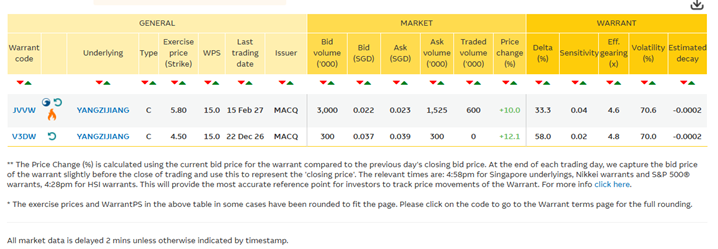
For investors who remain constructive on the longer-term outlook, one could consider gaining exposure through the shares (BS6.SI) or, for those who fully understand the associated risks and mechanics, trending Yangzijiang call warrant JVVW can provide magnified exposure of 4.6 times, based on the below screenshot below captured on 2 November 2026 (Table 1).
Ultimately, the recent correction warrants attention, but investment decisions should be based on both fundamentals and valuations rather than share price movements alone.
As always, appropriate position sizing and risk management remain important considerations.
*Trending warrants refer to those with the tightest spreads and highest liquidity
Table 1: YZJSGD call warrants
Disclaimer:
This commentary piece is paid for Macquarie Warrants Singapore. The views expressed by Ernest Lim do not represent the views of Macquarie Group, nor its affiliates. This advertisement has not been reviewed by the Monetary Authority of Singapore. Investment products including warrants are subject to significant investment risks, including the possible loss of the principal amount invested. Where past performance is referred to, it is not indicative of future performance. Examples quoted in this presentation are for illustration purposes only and do not represent any investment views or strategies. Advice should be sought from a financial adviser regarding the suitability of the investment product before you commit to invest in it. Macquarie does not endorse any call to action by Ernest Lim inviting viewers or readers to join his community, WhatsApp groups or similar groups or channels.
Refer HERE for further disclaimers